Why Horses Don't Want to Pick Up or Hold Up a Foot
When a horse resists picking up a foot, it is usually treated as a training issue. The assumption is that the horse is being difficult, uncooperative, or simply needs to learn to stand still and comply. Sometimes that is the case. But in many horses, especially those that struggle to hold a foot up even after they understand what is being asked, the problem is not unwillingness.
It is that the body cannot comfortably support the request. Lifting a foot requires more than moving a limb. It requires the rest of the body to reorganize and support that shift in balance. When one foot leaves the ground, the horse must redistribute weight, stabilize through the remaining limbs, organize through the core and ribcage, and maintain balance without bracing. If any part of that system is not available, the task becomes difficult very quickly.
In many horses, resistance to picking up a foot is linked to tension patterns that limit stability. The horse may be holding through the ribcage, bracing through the shoulder, or unable to organize through the pelvis. When that happens, removing one point of support creates a sense of instability, and the body responds by tightening. This is often felt as sudden resistance, pulling away, leaning, or putting the foot back down. In some cases, this tightening becomes more specific. As the horse tries to hold the position, protective contractions can occur through the muscles that support the limb and stabilize the body. These are often described as muscle spasms, but they are not random. They are the system attempting to prevent further instability. The horse is not resisting the person. It is responding to a moment where holding the foot up no longer feels manageable.
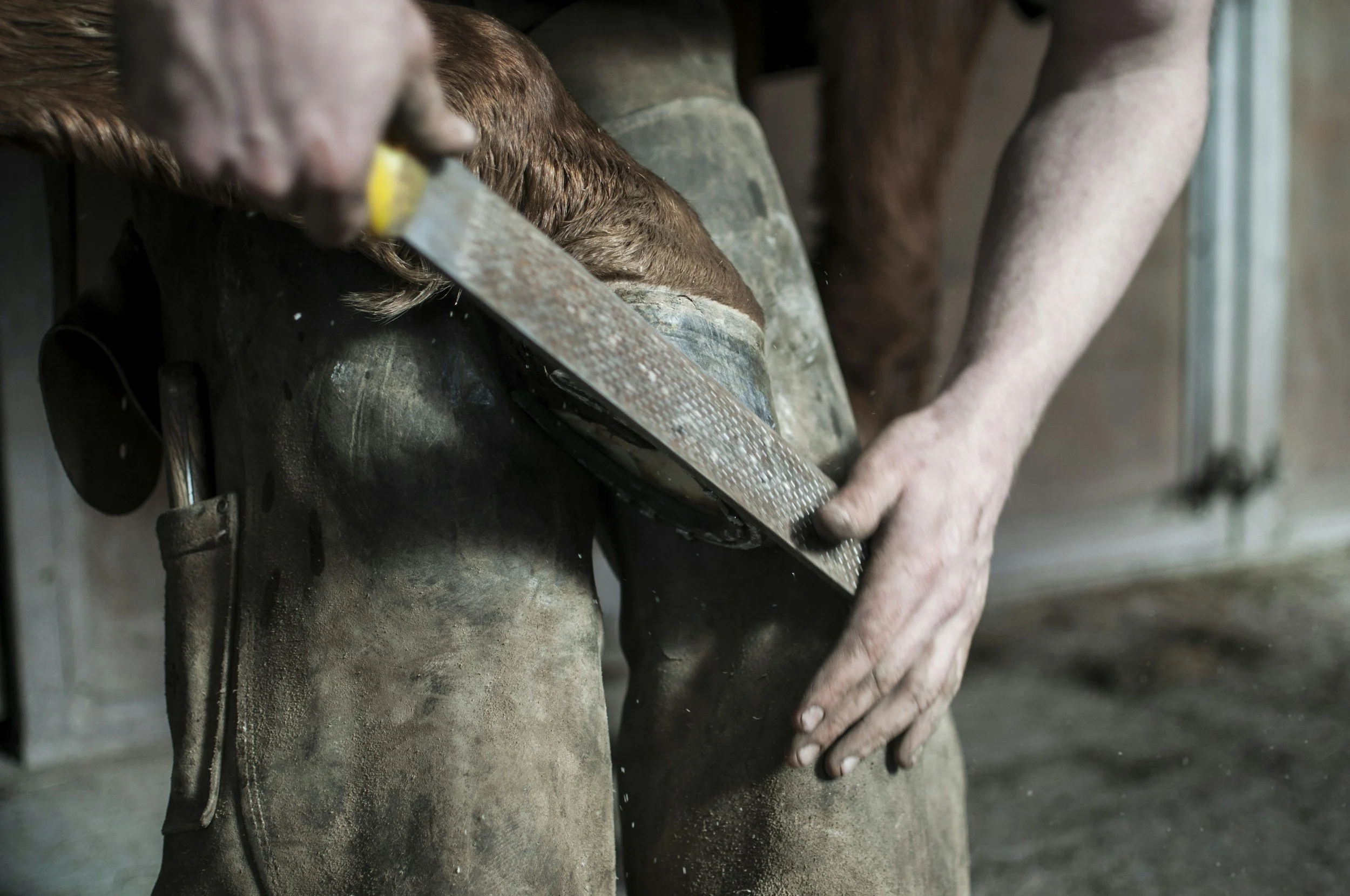
This is why the behavior often shows up during routine handling, such as when the farrier picks up the foot, when cleaning hooves, or when the horse is asked to hold the leg longer than it can comfortably manage. The horse may comply at first, but as the system reaches its limit, the response changes. The foot is pulled away, dropped, or resisted, not because the horse does not understand, but because it cannot sustain the position. If the issue is rooted in stability and organization, repetition alone does not resolve it. The horse may learn to tolerate the request briefly, but the underlying pattern remains, which is why some horses never get easier to hold up, become more reactive over time, or only cooperate under pressure.
When the body becomes more organized, the behavior often changes without being directly trained. As the ribcage begins to move, the shoulders and pelvis stabilize, and the horse can redistribute weight more effectively, lifting a foot no longer creates the same level of instability. The protective response decreases, and the horse can hold the limb up because the rest of the body can support it. In many horses, resistance to picking up or holding a foot is not a matter of attitude. It is a reflection of how the body is organizing under load. What looks like unwillingness is often a moment where the system cannot maintain balance without tightening. When that changes, the behavior changes with it, because the horse is no longer trying to protect itself from something it cannot comfortably manage.
Why Biting is Not Always Aggression
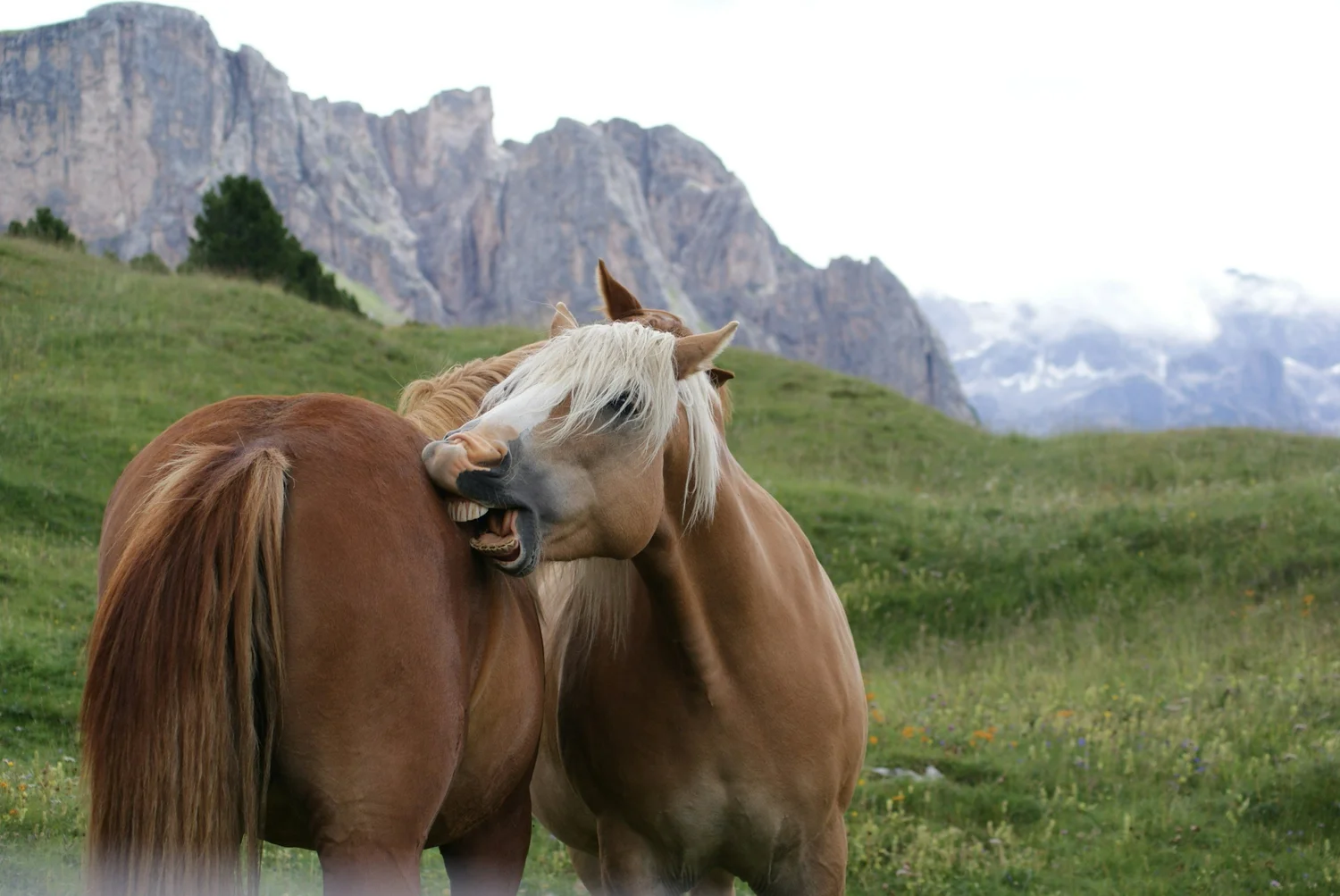
Biting is usually treated as a behavioural problem. A horse reaches toward a person with its mouth and the response is immediate: correction, boundaries, discipline. The assumption is that the horse is being aggressive, disrespectful, or dominant. Sometimes that is true. But in many horses, especially those that bite in repeatable situations, the behaviour is not random and it is not purely aggressive. It is part of a pattern, and often, it is part of communication.
Horses do not have many ways to tell us that something is not organizing well in their body. They do not explain tension, restriction, or imbalance in words. Instead, they show it through movement, posture, and sometimes through behaviour. The mouth is one of the clearest ways they can reach out. Many horses that bite are not striking outward in anger; they are reaching toward something — the person, the hand, or the area being touched. In that moment, the behaviour can be less about pushing someone away and more about trying to change what is happening.
If you watch closely, the behaviour often appears alongside very specific physical patterns. The jaw is tight, the base of the neck is restricted, and the shoulder does not move freely. The front of the body is carrying more than it can comfortably manage. When this happens, the horse will often try to create change where it still has access, and the mouth becomes active — not necessarily as aggression, but as an attempt to interact with the situation.
In many cases, biting shows up at predictable moments — during grooming, when the girth is tightened, while being blanketed, during hand walking, when standing still, or when pressure is applied. These are all situations where the horse may feel restricted, compressed, or unable to move. The bite can be an attempt to indicate that something in that moment is not working, that the horse cannot organize comfortably around what is being asked, or that it needs the situation to change. It is not a precise language, but it is not meaningless either.
If the underlying pattern does not change, the behaviour often repeats. Correction may stop the moment, but it does not change what the horse is experiencing. The next time the same feeling shows up in the body, the same response appears — not because the horse is choosing it, but because the system is trying again to communicate or resolve the same problem.
When the body begins to organize differently, the behaviour often fades without being directly addressed. As the jaw softens, the ribcage begins to move, and the shoulder frees, the horse no longer needs to reach outward in the same way. The system has another option. The communication changes because the need for it changes.
Understanding biting as communication does not mean allowing unsafe behaviour. Clear boundaries are still necessary. But if the goal is lasting change, the behaviour has to be understood in context, not just corrected but listened to.
In many horses, biting is not simply a sign of aggression. It is an attempt to interact with something that is not working — a form of communication from a system that does not have many ways to explain itself. When we begin to look at the pattern behind the behavior, the horse starts to make more sense. And when the horse makes sense, the behavior often changes.
Rehabilitation After a Tie-Back Injury
Rehabilitation after a tie-back injury is often approached as a problem of the neck. Something that needs to be loosened, stretched, or mobilized so the horse can move freely again. But what changes most in these horses is not just tissue. It is the nervous system’s expectation of what pressure means.
A horse that has pulled back and felt trapped does not simply return to neutral once the event is over. The experience reorganizes how the system anticipates pressure, balance, and the possibility of forward movement. The poll and halter become associated with a loss of control, and from that point on, contact is no longer just contact. It carries a prediction.
When pressure predicts confinement, the body organizes accordingly. The neck braces, the ribcage quiets, forward movement shortens, and the system shifts toward protection rather than exploration. These responses are not chosen behaviors. They are coherent, repeatable patterns shaped by what the horse has learned to expect.
This is why attempts to restore movement by working locally in the neck often produce limited or temporary change. The system is not resisting mobility. It is maintaining safety.
Rehabilitation begins when that prediction starts to change.
This does not happen through force or repetition, but through the gradual restoration of options. When the horse begins to experience pressure without losing the ability to move, even in small ways, the meaning of that pressure begins to shift. The poll is no longer a fixed point of alarm, but a place where communication can occur without consequence.
As this changes, the rest of the body begins to reorganize. Forward movement no longer feels like something that will be taken away. The head and neck are able to orient more freely, not because they have been placed there, but because the system no longer needs to hold them in protection. Breathing deepens, the ribcage begins to move again, and the body rediscovers a pathway through space that does not require bracing.
From there, changes that are often treated as goals begin to appear on their own. The thoracic sling engages, the scapula frees, and the forelimb step lengthens, not as trained outcomes, but as consequences of a system that can once again organize around movement rather than restriction.
Contact only becomes meaningful at this point. When the horse no longer expects pressure to remove its options, it can move into the hand without losing balance or safety. What looks like connection is simply the absence of conflict between forward movement and perceived constraint.
The visible changes in topline, straightness, and consistency are not created directly. They emerge as the nervous system replaces the original survival strategy with a new internal map, one in which pressure no longer predicts confinement and forward movement becomes available again.
Rehabilitation, in this sense, is not about returning the horse to a previous state. It is about changing what the system believes is possible.